Jev atlas

Decisions, not text.

Everything we found on Jev-style decision models: the papers, the open models, the leaderboards, and a code-level audit of 27 implementations. Jev appeared on 15 September 2026. By mid-October about 130 papers mentioned it, and nearly 2,000 Hugging Face models were tagged as decision models.

Numbers are as reported by each source; claims taken from a README, model card or notes rather than a paper table are marked (self-reported).

Compiled 15–16 Oct 2026 · Vangelis Kazakos

What Jev is

One forward pass, one calibrated distribution.

Jev is a closed "System One" decision model from TypeSafe AI, launched 15 September 2026. It answers a typed question about a state with a calibrated probability, without generating text. The open work below copies its interface.

Choice→ distribution over ≤255 options

Pick one of the declared options. "None of these" is not a primitive; some open models add it as an option or a separate gate.

Score→ distribution over rubric levels

Place the input on a declared scale, for example 1–5 relevance.

Noul→ P(yes)

Probability that the answer to a yes/no question is yes.

schematic: the glyphs show the output type, not data

Inputs
statequestionoptionsState (the context: a document, a screen, a video), question (what to decide), options (the candidates).
Training
Jev is trained with RLCD, "Reinforcement Learning for Calibrated Decisions". The objective and data source are public. The method, reward and base model are not.
Name clash
"RL from Contrastive Distillation" (Yang et al., ICLR 2024) is unrelated.

Text papers

Five papers to read first.

The five we found most notable, then the rest. All appeared after Jev's 15 Sep launch, so citation counts are not yet meaningful.

13 OctArch

Jeva: System One Models from First Principles

Request and each option are encoded separately (options cacheable). A small decision block lets the request vector read the whole option set before scoring, and a coverage gate gives an explicit "none". Supervised plus filtered distillation, no RL. Run at 2,048 options.

30 SepRL

OpenJev-RLCD: A Working RLCD Implementation

First open version of Jev's RL, on Qwen3-1.7B. Rewards the committed answer distribution with a strictly proper scoring rule: calibrate first, then reinforce. Beats SFT, RFT and GRPO on selective prediction; cannot beat CE when uncertainty is annotator disagreement.

12 OctRL

StartLux-Decision: RL for Calibrated Deliberative Decisions (RLCD²)

0.8B–27B models that reason only when uncertain, trained with RL and proper scoring rules against a frozen reference. 73.4 on Decision Index 0.3. RL training code not released.

12 OctRecipe

Releasing the Inner Jev: A Simple Recipe for Open Decision Models

Read option-letter logits from open LLMs, then LoRA fine-tune. Matches or beats Jev on decision tasks. Its ablation: LoRA drives the gain, not the head (Gemma 4 31B, Capability on OpenDecisions: head only 78.9, LoRA 84.9).

29 SepEval

Evaluating and Benchmarking the System One Model Jev

The main independent evaluation of Jev: 37 datasets, calibration, comparisons with open Qwen and Gemma models.

More text recipes and studies

LLM-as-Jev

Numbered options read through a prefix-free trie (unbounded K); KL anchors stop generation from degrading. Paper only.

AnyJev

Training-free readout from any LLM; averaging over option rotations cuts answer flips from 0.230 to 0.073. Code → evidence

FunDM

Label-free decision head on a frozen LLM, distilled from the full model; 75.0 vs 75.7 using 24 of 36 layers. Code

General Decision Models / JEVal

Self-distilled decision models; finds they pick the likely outcome but overstate its probability.

Runoff

Order invariance for multiple-choice decisions.

Can Jev be your Q or Policy?

Jev used as policy, score rater, meta-regulator and transition model inside RL loops.

Chinese-Jev

Laya-family encoder for Chinese with GRPO-style RLCD and DDP training. Code

Just Ask Jev

RLCD-trained decisions used as a zero-shot detector.

TypedBench

A paper benchmark for typed decisions: calibration, sensitivity to wording, cost.

Vision and video

Beyond text: one video grounder, one bi-encoder, image-side speed-ups.

Everything Jev-style we found beyond text.

13 OctVideo

VideoJev

4B and 35B-A3B models. One sequence [video → question → one timestamp option per 2 frames → decide token]; the decide token scores every option. Independent "inside the event" probabilities, BCE plus soft-IoU loss, Kadane decoding. Average mIoU 65.3 (4B) on Charades-STA, ActivityNet and QVHighlights. Short and medium clips only.

8 OctMeta

MetaEncoder

A 30B decoder used as a bi-encoder: request and candidates encoded separately, text plus image and video, for decisions and million-scale retrieval. Evaluation code only.

22 SepImage

Visual Jev

Encode an image once, answer many multiple-choice questions in a batch: 8.9× faster. A new typed head tied the plain LM-head readout.

8 OctSpeed

FastJEV

Training-free speed-ups for multimodal candidate scoring (prefix sharing, pruning): −44% candidate depth. Built on OmniJev, whose option scorer has an explicit abstain logit.

30 SepMedical

OmniMed-Jev

Calibrated candidate decisions on medical images. Its head lets candidates attend to each other (with log K as a feature), conditioned on the query.

Applications

PixelJev

Small VLMs (2B, 4B) making Jev-style choices on images; object and action selection left as future work. Paper only.

NavJev

Vision-language navigation with compressed visual candidate actions; R2R-CE 27.0 SR at 0.65 s per step.

Jev-Mobile

The closed Jev API picks phone-UI actions; a VLM plans only occasionally. −73% cost.

System Switch

A fast decision model hands over to a reasoning VLM when a gate opens (Doom).

RSAJEV

Remote-sensing classification with a calibrated "abstain" option.

AgriJev

Agriculture candidate scoring with adapted Qwen3.5 models.

JEVQA

Zero-shot video quality prediction with a decision model.

Visual Jev Rewards

A visual verifier whose yes-probabilities are GRPO rewards for image generation.

DecisionRobust

Robustness benchmark for decision models, text and vision.

Open models

Text-only weights go down to 17M; multimodal starts at 0.6B.

Weights you can download, multimodal first. Video support means whole-clip question answering at 2 fps.

model
10M100M1B10B
sizes as statedinputs
  1. Multimodal, smallest to largest
  2. vllm-sr Decision 3.0 (d3)0.6B–26BIVfamily

    Text, images, video at 2 fps (max 32 frames). #1 on the Jev Decision Index text board (66.3) and its Vision Index (71.3)(self-reported). Noncausal attention; trained on AMD MI325X. audit ↗

  3. LiquidAI d1-omni-600M, d1-3B0.6B / 3BIAA: 600M only

    0.6B: text, image, speech, no video. d1-3B: text and images.

  4. Decider 2B vision2Bvision

    Letter readout with option-count temperature calibration. audit ↗

  5. h2o-lightning-4b4BI

    4B, text and image; #1 open-weight on JevBench 7–15 Oct (72.5), per its model card(self-reported). The live board has since moved (Quyet-1.0-Large leads; see leaderboards).

  6. Cloudflare clef · flash · omni9B / 27B / 35B?IVAI V A: omni

    27B / 9B / 35B. clef-omni reads text, image, audio and video; a joint schema head scores all options of all questions. No training code. audit ↗

  7. autotrust JEV-27B-VL27BI

    27B, image; distilled from Jev outputs.

  8. Text-only, smallest to largest
  9. bekko-system-one17M / 68M / 400M

    Sentence-Transformers based, runs in the browser; second on S1MB behind Jev in the board's 30 Sep snapshot(self-reported). audit ↗

  10. Julia-1144M

    Laya architecture on mmBERT-small; weights and inference only.

  11. Laya322M / 421M

    ModernBERT / mmBERT encoders; the most-starred open System-One repo. audit ↗

  12. Von395M

    ModernBERT-large, CPU-served under 15 ms(self-reported); options masked from each other. audit ↗

  13. NanoJev0.6B

    Qwen3-0.6B trained on game decisions (ViZDoom, Maze, Snake). audit ↗

  14. AgentJev0.6B

    Order-invariant candidate set encoder on Qwen3-0.6B. audit ↗

  15. Kev0.8B–27B

    Pointer head from a decide token; best-engineered open repo. audit ↗

  16. Tev10.8B / 4B

    Letter SFT through a Together API job; uncalibrated by its own README(self-reported). audit ↗

  17. Decider2B / 4B / 35B-A3B

    Letter readout, per-option-count temperature, GGUF and vLLM serving. audit ↗

  18. Open-Jev2B / 9B / 27B

    Cross-encoder yes/no per option, CE plus Brier, one fitted temperature. audit ↗

  19. JevK54B / 9B

    Letter readout with a calibrated knockout for 100+ options; #2 of 76 on JevBench v1.4(self-reported). audit ↗

  20. CLM8B backbone

    Two-tower contrastive heads; cleanest cacheable reference. audit ↗

10M100M1B10B
FIG. 1 Released sizes of the open models, parameters on a log scale. Dots are sizes stated by each card; a solid line joins several stated sizes, a dashed line is a stated range whose intermediate sizes are not listed; ring = mixture-of-experts at total parameters. video inputimage inputtext onlymodality not statedinputs: I image · V video · A audio/speech · ? not stated · text for all Source: model cards and repos linked in each row · as of 16 Oct 2026. Paper-released video weights: VideoJev-4B.

Demos

Eleven demos worth trying.

We found 282 live demos of Jev-style models (all checked on 16 Oct 2026). These eleven are the most carefully made and show the most: probabilities, calibration, abstention, latency, the one-pass mechanics, and two robots in simulation (one live, one recorded). Screenshots 16 Oct; click one to open the demo.

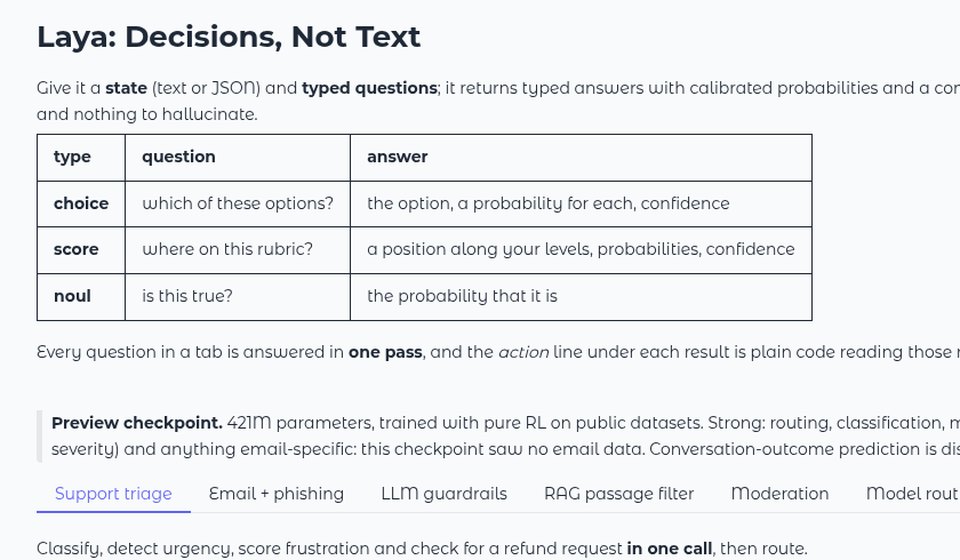
Screenshot of the Laya Demo demo
Laya Demo♥ 276
Laya · 421Mtextconvaiinnovations

Support triage, guardrails, routing and more, each answered in one pass with a probability per option; the thresholds live in your code, not in the model.

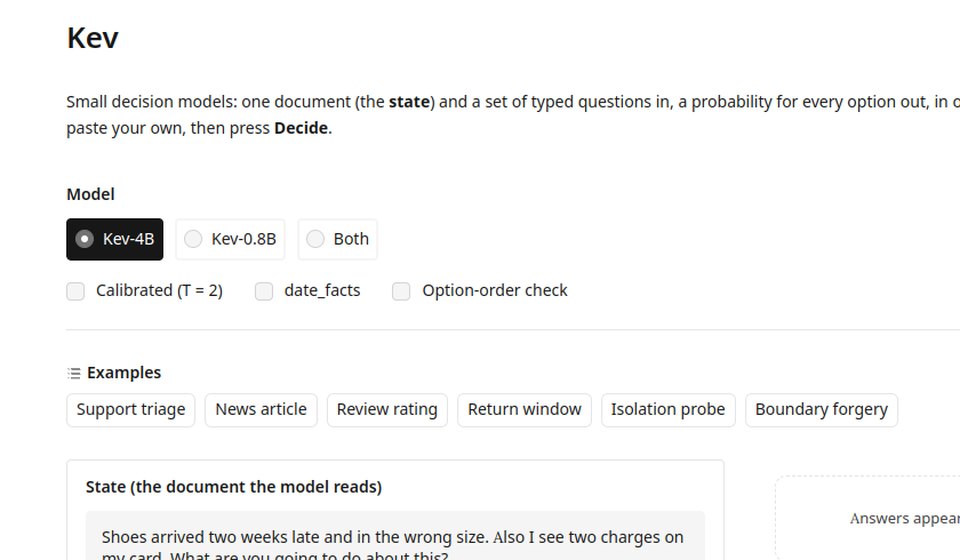
Screenshot of the Kev demo
Kev♥ 88
Kev · 0.8B / 4BtextJared Palmer

Jev's /v1/systemone request format with both sizes side by side, plus probes for question isolation and option-boundary forgery.

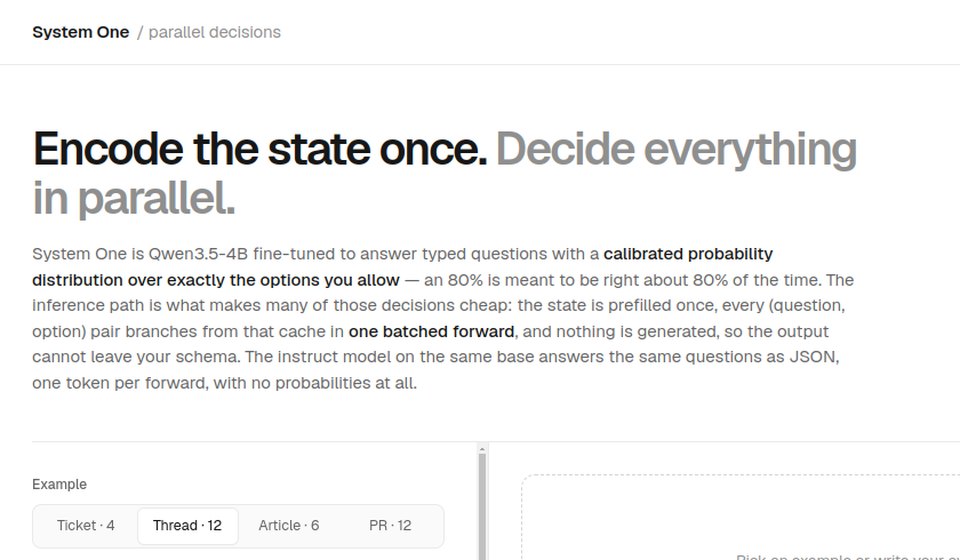
Screenshot of the Open Jev demo
Open Jev♥ 40
Qwen3.5-4B scorertextpngwn

Encode the state once, decide in parallel: cached vs naive scoring vs JSON generation, with forward-pass counts.

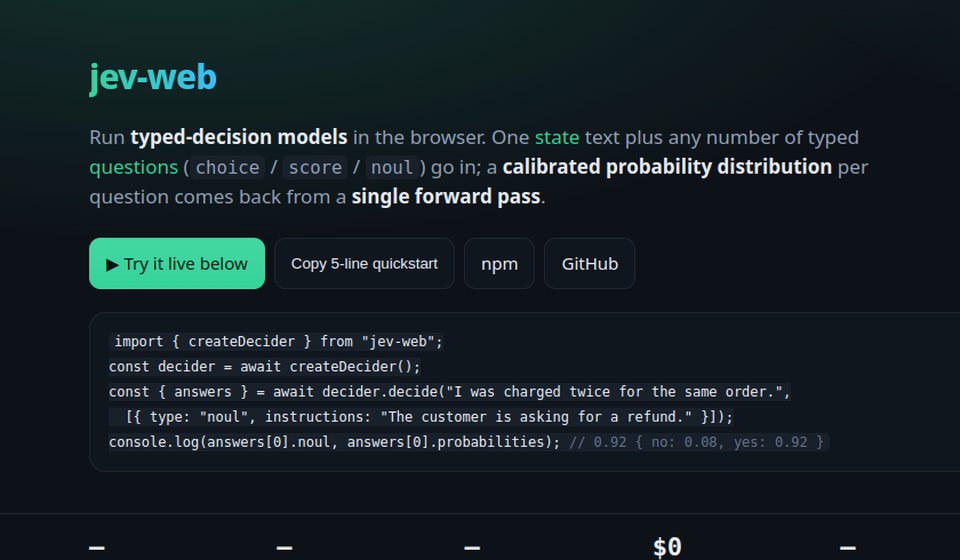
Screenshot of the jev-web demo
~10 open modelsin browserwarsang

Switch between open decision models on the same input, on your own device, with latency and forward passes counted.

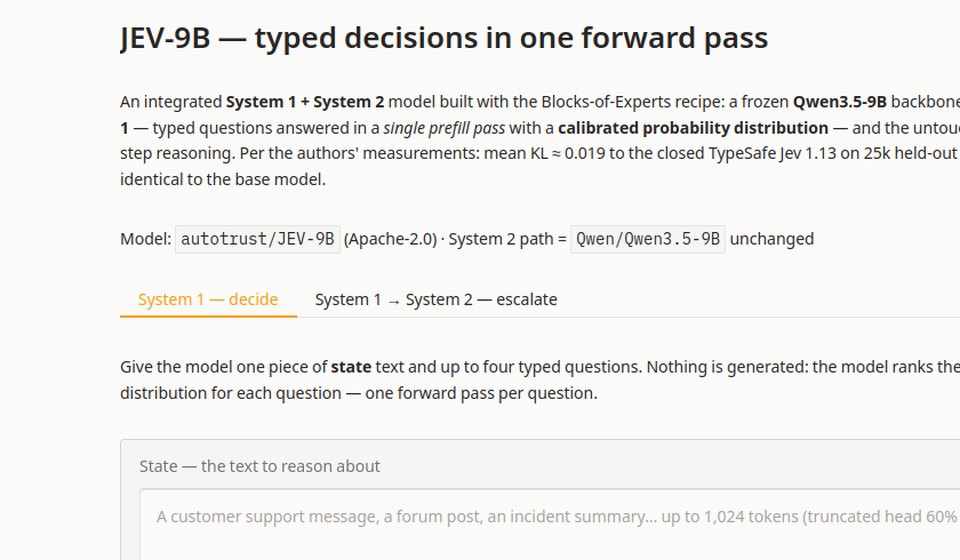
Screenshot of the JEV-9B · System 1 + 2 demo
JEV-9BtextAutoTrust

Calibrated distributions in one pass; an Escalate tab hands low-confidence questions to System 2 thinking with the same weights.

Screenshot of the imajev demo
imajev♥ 14
imajev-4Bimage + textmohit67890

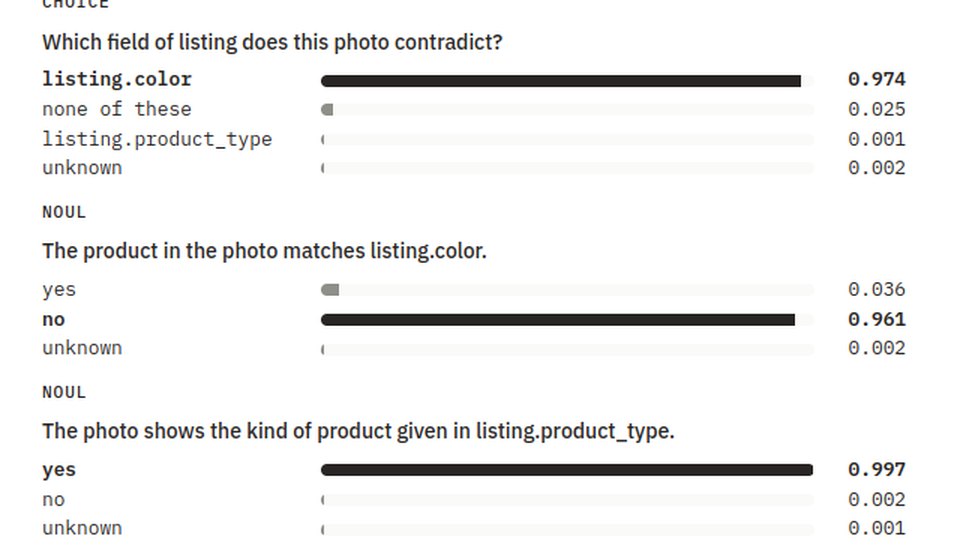
Photo-against-record checks with an explicit can't-tell probability, so you can trade coverage for accuracy.

Screenshot of the Decision 3.0 demo
d3 familytext · image · videovLLM Semantic Router · official

A probability for every answer on text, images and video; models side by side with latency; boxes scored on a zooming grid.

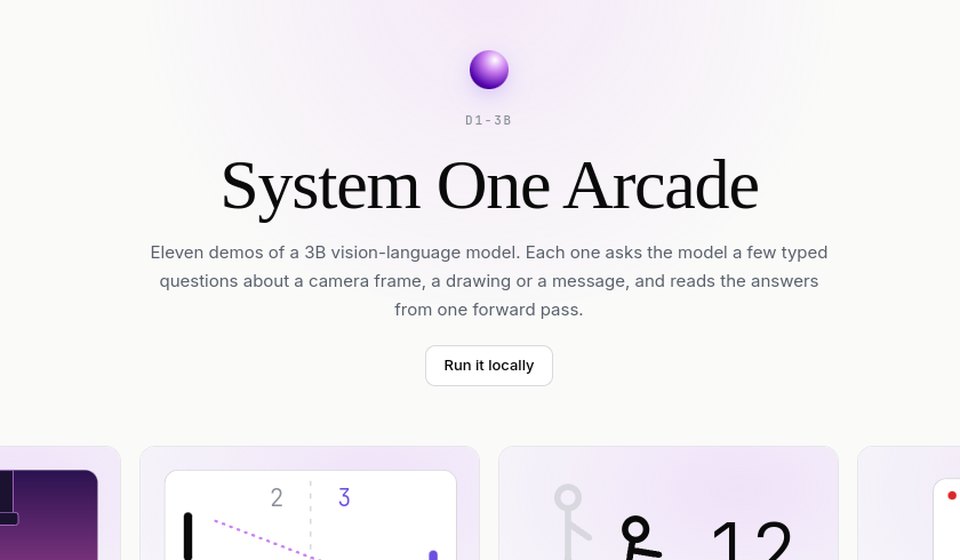
Screenshot of the System One Arcade demo
d1-3Bcamera · drawingLiquidAI · official

Eleven camera and drawing mini-games, each driven by a few typed questions answered in one pass.

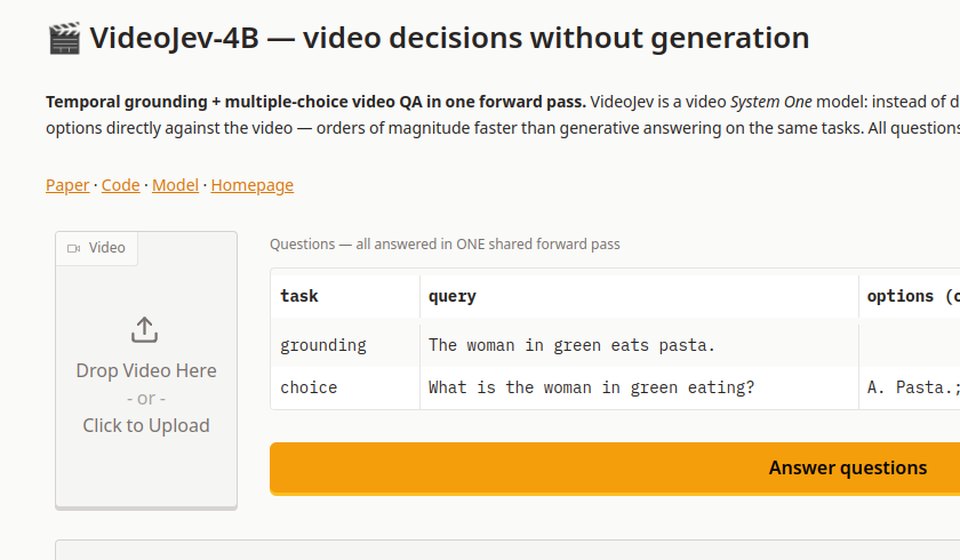
Screenshot of the VideoJev demo
VideoJev-4Bvideohugging-apps

Temporal grounding and video QA in one pass, with a probability per timestamp; several questions share one video encoding.

Embodied, in simulators

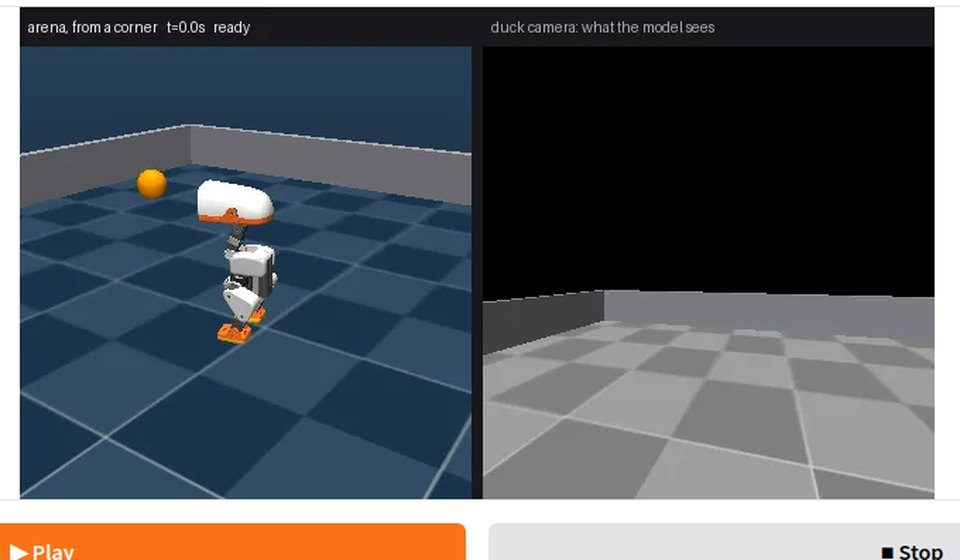
Screenshot of the Laya Vision plays find-and-kick demo
Laya Visionrobot camera · MuJoCothaitea

A simulated Pollen Microduck sees only its own camera; each step the model picks forward, left, right or kick, about 70 ms per decision, on the action space of a published eval.

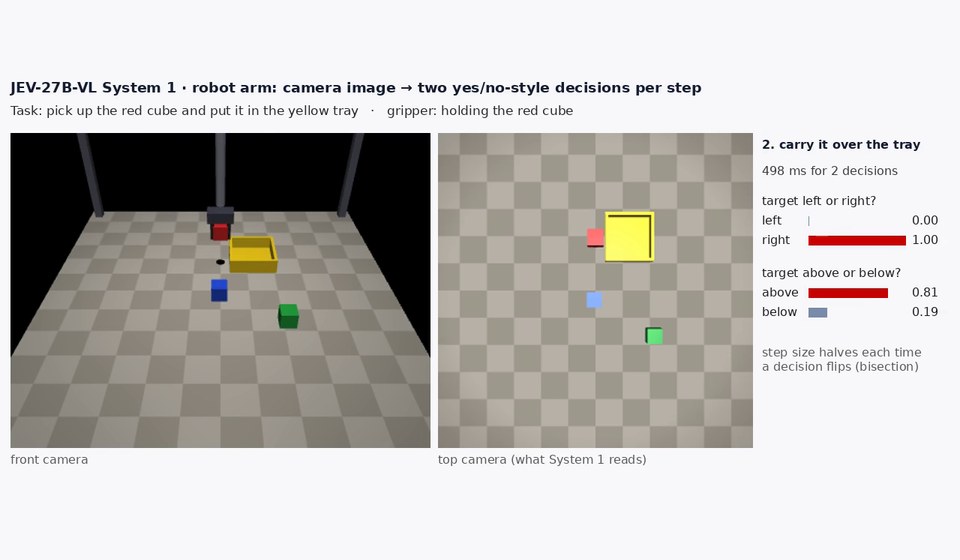
Screenshot of the JEV-27B-VL · robot arm demo
JEV-27B-VLrobot camera · MuJoCoAutoTrust · recorded videos

Each step the model reads the top camera and answers two questions, is the target left or right of the gripper and above or below it; the arm grasps the cube and drops it in the tray. 75% of 20 random scenes, about 240 ms per decision, per the model card (self-reported).

to try closed Jev itself: TypeSafe playground (account) · OpenRouter playground (credits)

Benchmarks and leaderboards

Five boards, five definitions of good.

Where decision models are ranked. Screenshots taken on 16 October 2026, except jev-bench, which shows the board's own chart; click an image for the live board.

BoardVersion · sizeMeasuresLeader, as statedJev, as stated
Decision Indexv0.3.2 · 168 models37 public benchmarks + private tests · text and vision boardsvLLM-SR d3 27B⁴ 66.3 full scoreJev 1.14 61.5 full score
DecideBenchv1.1 · 400 decisionsaccuracy · cost per M tasks · latencyoverall leader: a chat LLM¹JEV 98.0% accleads the decision models
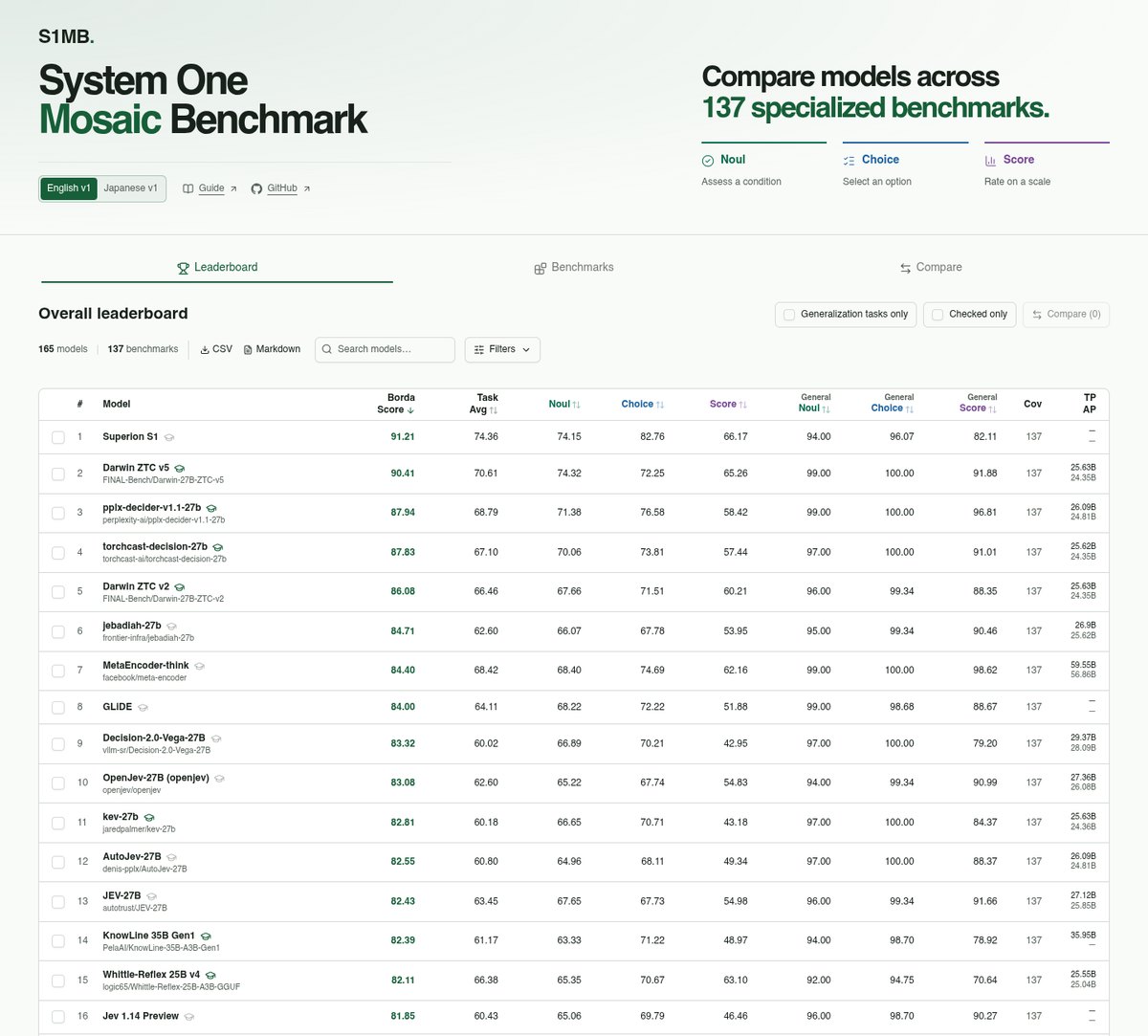
System One Mosaic Benchmark165 models · 137 benchmarkstext only · Borda score over Noul, Choice, ScoreSuperion S1 91.21 BordaJev 1.14 Preview² 81.85 Borda
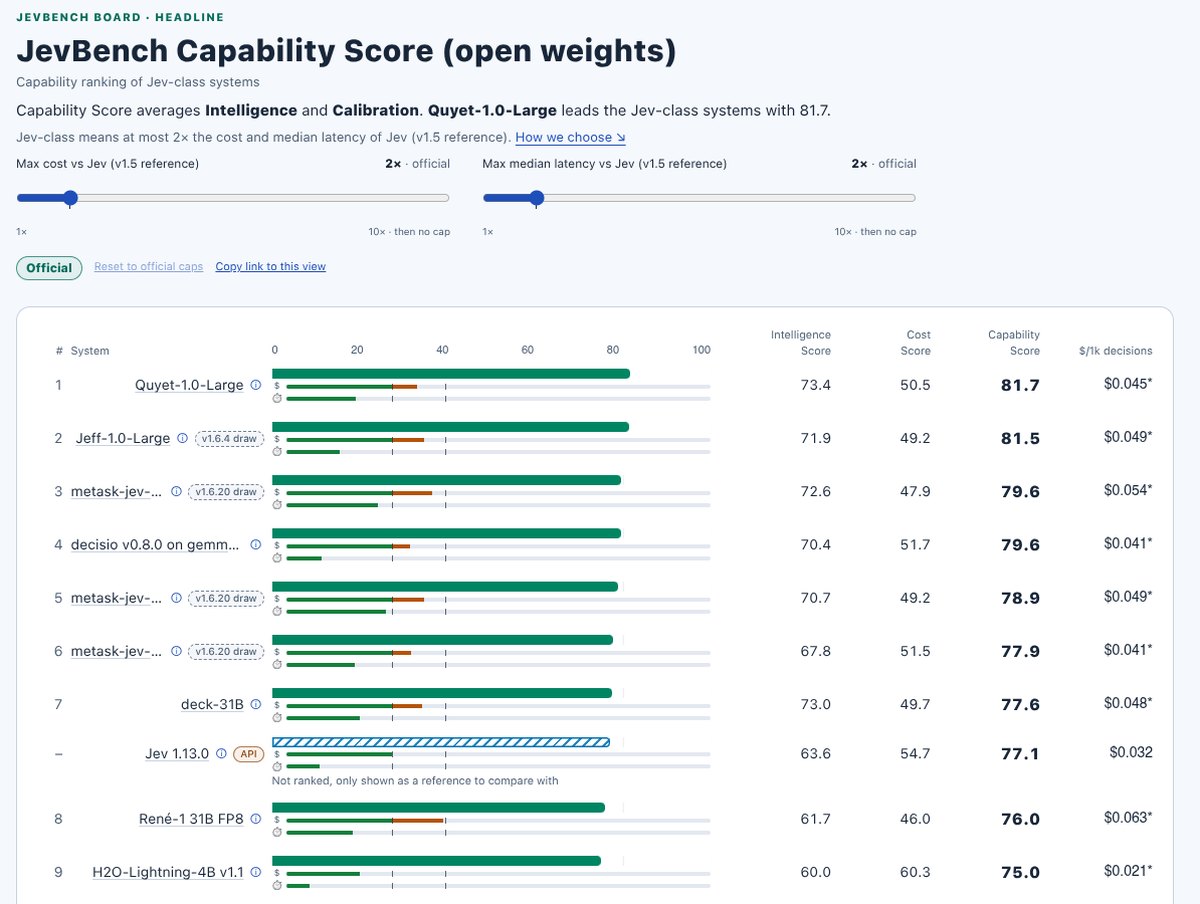
JevBenchv1.7.46 · 162 rankedintelligence · calibration · cost · latencyQuyet-1.0-Large 81.7 capabilityJev 1.13.0 77.1 capability
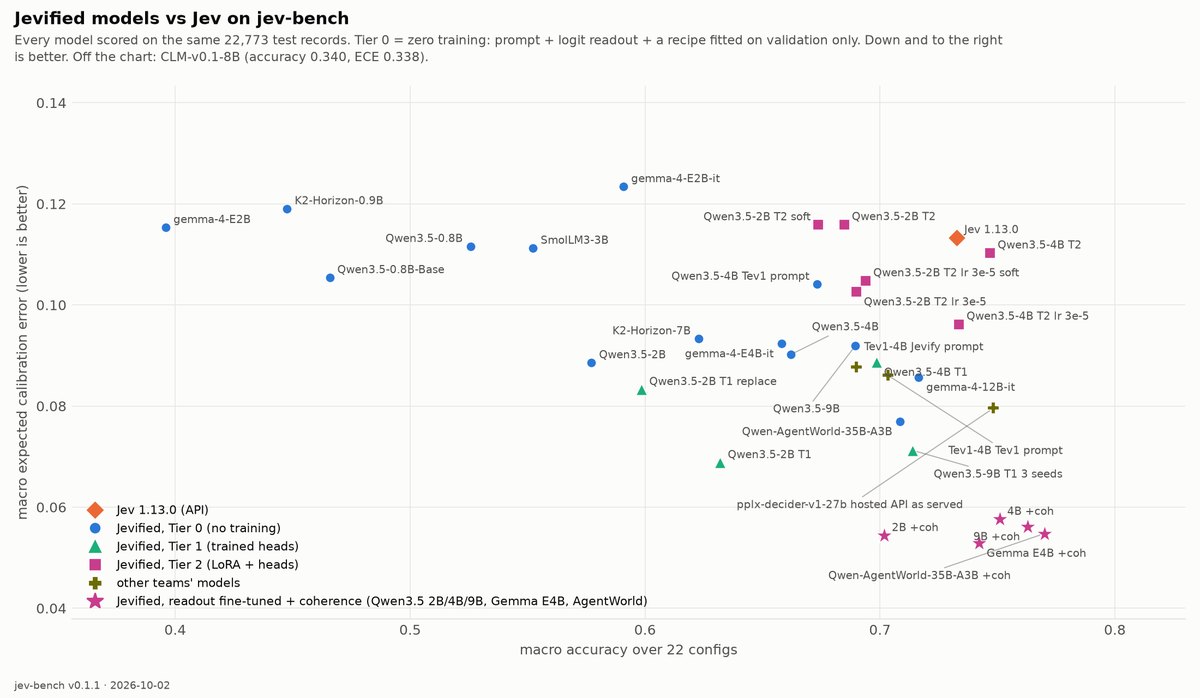
jev-benchv0.1.1 · 22,773 recordsaccuracy vs calibration error, human labelsopen readout-fine-tuned models³Jev 1.13.0 0.733 acc · 0.113 ECE
TABLE 1Each board uses its own metric and test set: compare within a row, never down a column. ¹ DecideBench ranks chat LLMs (DeepSeek-V4-Flash, 99.8%) above all decision models. ² rank 16 on the live board. ³ readout-fine-tuned open models beat Jev on both accuracy and calibration error. ⁴ size as written on the board; the d3 model card lists 0.6B–26B. Source: the five live boards · snapshots 16 Oct 2026 (jev-bench chart 2 Oct)
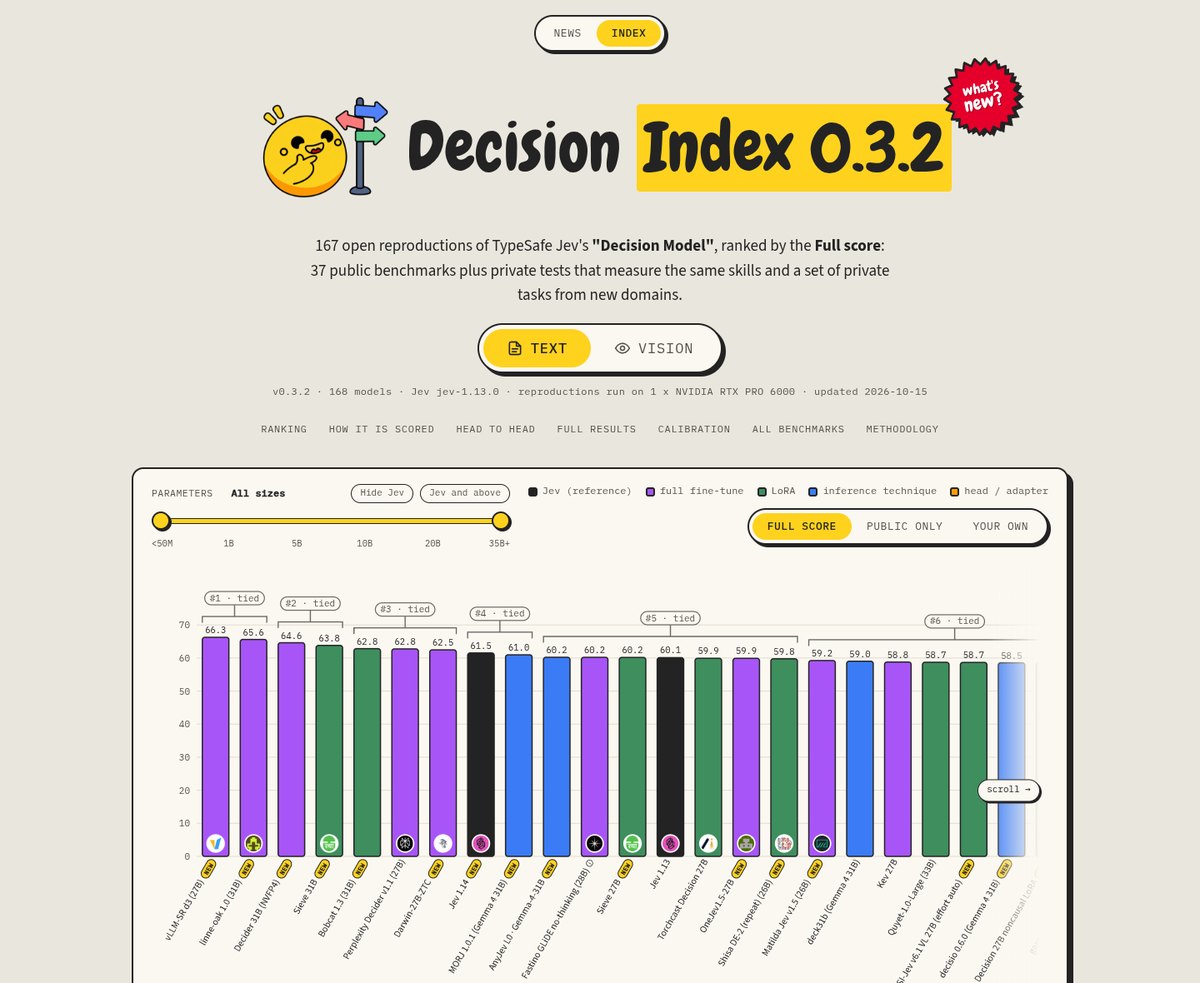
Decision Index 0.3.2 bar chart of the top open decision models by full score
Decision Indexv0.3.2 · 168 models

The main board for open Jev reproductions: 37 public benchmarks plus private tests, with separate text and vision boards. Top on 16 Oct: vLLM-SR d3 27B (66.3); Jev 1.14 at 61.5.

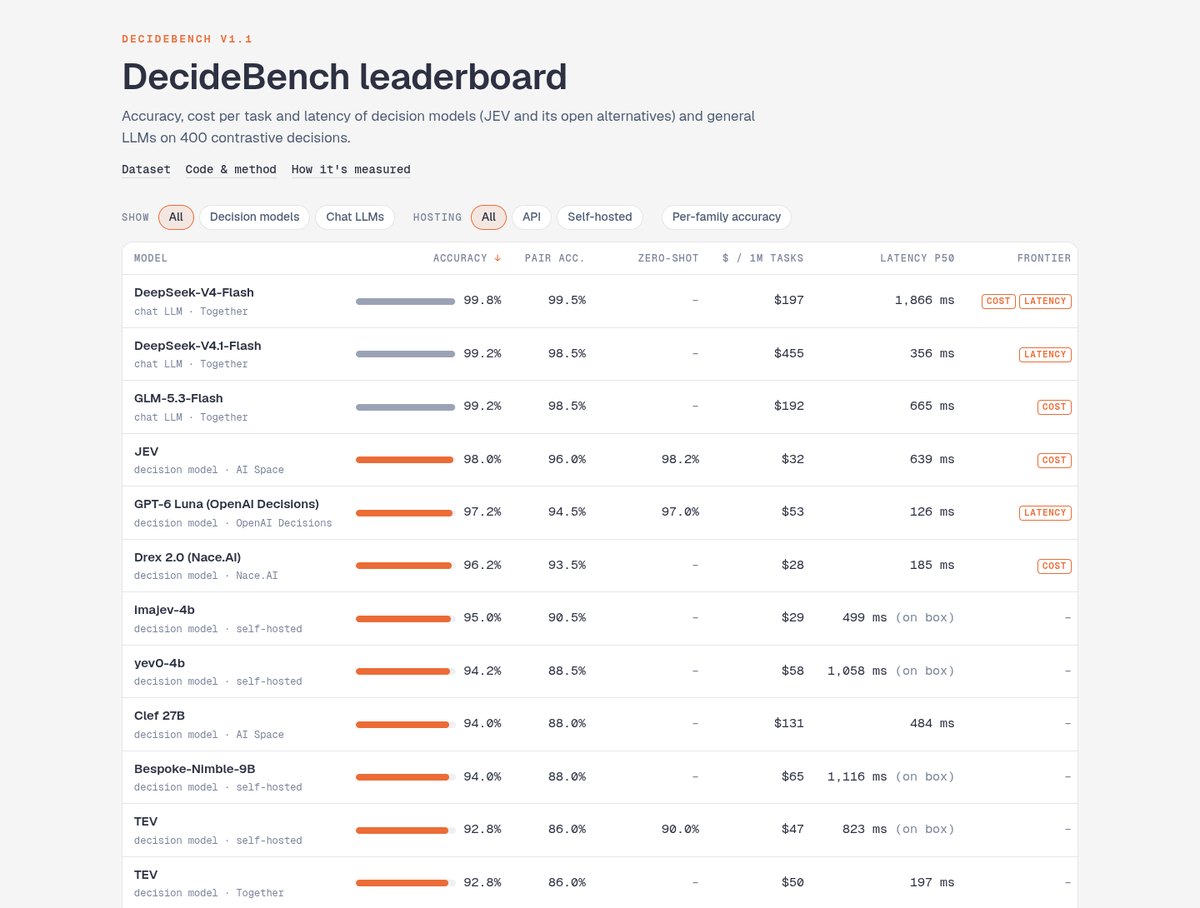
DecideBench v1.1 table of accuracy, cost per million tasks and latency
DecideBenchv1.1 · 400 decisions

Accuracy, cost per million tasks and latency, decision models next to chat LLMs. JEV leads the decision models at 98.0%. Code

System One Mosaic Benchmark overall leaderboard by Borda score
System One Mosaic Benchmark165 models · 137 benchmarks

Text only, ranked by Borda score across Noul, Choice and Score tasks. Superion S1 leads (91.21). Write-up

JevBench capability ranking of open-weight decision models, Quyet-1.0-Large first at 81.7
JevBenchboard v1.7.46 · 162 ranked

Intelligence, calibration, cost and latency, run independently of TypeSafe. The capability score averages intelligence and calibration over systems within 2× Jev's cost and latency. Quyet-1.0-Large leads (81.7); Jev 1.13.0 scores 77.1 as the reference.

jev-bench chart of every model: macro accuracy against calibration error, Jev 1.13.0 marked
jev-benchv0.1.1 · 22,773 test records

Every model on the same human-labelled test set, accuracy against calibration error. Jev 1.13.0: 0.733 accuracy, ECE 0.113; readout-fine-tuned open models beat it on both. Chart from the dataset card (2 Oct).

Where to browse

Unranked collections of models and papers.

Places that collect decision models and papers without ranking them.

Hugging Face tag Every model its authors tagged as a decision model.

Hugging Face search Repos with "jev" in the name, most liked first.

systemonemodels.ai A directory of decision models with self-reported scores(self-reported), which are not comparable across models.

arXiv search Papers mentioning Jev, 19 Sep – 14 Oct 2026.

Code audit

22 of 27 audited repos encode request and options jointly.

We read the code of 27 implementations, all scored the same way. The first question for any design: are the request and the options encoded together in one sequence (joint), or separately (cacheable options)? Stars as of 15 Oct 2026.

LLM heads · 5
encoders · 7
recipes · 9
vision/video · 6
joint 22 shared prefix 2 separate 3
FIG. 2One square per repo, in table order; click one to jump to its row. Joint: request and options in one sequence. Separate: options encoded without the request, so they can be cached. Source: the table below · code read 15–16 Oct 2026
RepoEncodingDecision headNoneMax optionsStars · 15 OctTake-away
Text, decision heads on LLM backbones· 5
JevaseparateRequest vector reads the option set (attention), then dot productgate2,048 tested76Only design built for cacheable options; head is 470 lines of plain PyTorch
KevjointDecide-token pointer over option tokensno2559,178Best engineering (447 tests, ROCm); notes record that isolation and head width did not help(self-reported)
NanoJevjointPer-option scalar + set attentionno2552,552Proper-score RL estimator, found no better than CE(self-reported)
DeciderjointLetter-token logitsno2551,147Best calibration practice: T(n) = a + b·ln n
AgentJevjoint2-layer set transformer over candidatesno255386Clean candidate set encoder (~60 lines)
Text, encoder models· 7
Layajoint2-layer head, MLP at each option markeruntrained3233,022Huge community; "RLCD" loss and per-K temperatures; shipped ECE 0.57(self-reported)
GLiNER2.5-DecidejointMLP per label tokenthreshold512 positions2,374Excellent engineering; options are tokens in a 512-position encoder
VonjointMLP at option markers; options masked from each otherno8K tokens906Order-invariant by construction; CE + 0.5·Brier
Bekkoshared prefixLinear + optional set attentionnono cap37Cleanest small code; set head marked experimental
Chinese-JevjointLaya headact head3216Compact RLCD + DDP
VerdictseparateCosine or logistic regressionconformalno cap3Right towers, no real head
BongardjointBilinear candidate × decision tokenno—37.5B, causal, no tests
Text, recipes and two-tower models· 9
CLMseparateCosine of two MLP headsnono cap3,033Clean two-tower; loses to joint heads (44.3% vs ~75%, FunDM's audit)
SemIfjointLetter logits, no trainingno164,829Interface demo
AnyJevjointLetter logits, rotation averagingno261,276Quantifies order bias → evidence
Open-JevjointYes/no scalar per optionnoK passes415CE + Brier, one temperature
StartLuxjointLetter logits, bidirectional promptoption26 + knockout415Explicit "none" costs no accuracy → evidence
Tev1jointLetter SFTno24236A data recipe
JevK5jointLetter logits + knockoutno16 per pass155Only calibrated recipe measured at 151 options
FunDMjointOne-layer set transformer over option statesno10 tested0Most liftable set head (~25 lines) → evidence
SII-DecisionjointFirst-token logitsno2553Self-distillation recipe
Vision and video· 6
VideoJevjointDecide-token pointer over timestamp optionsno1 per 2 frames123Best video evidence; soft-IoU +4.6 mIoU; CUDA-only kernels → evidence
OmniJevshared prefixFiLM-gated scorer per optionabstain—163Proper-score losses; options fully isolated
OmniMed-JevjointLinear + bilinear + set attentionnoany1Query-conditioned set head (~70 lines)
ClefjointOptions route evidence from a memory, questions attend to each otherno—HF onlyRichest head; no training code, no ablation
Visual JevjointLM-head lettersexperimental1646Typed head tied the LM head
vllm-sr d3joint255-code readout, noncausalno2556,180Only one verified on ROCm; no head training code
separate options encoded without the request, so they can be cachedjoint request and options in one sequenceshared prefix as labelled in the table

What the evidence says

Eight measured comparisons, each on its own metric.

No repository ablates its own head design. These are the measurements that exist, each from the cited source.

each plot: own metric, own axis from zero · ○ before ● after · dashed = README(self-reported)

A · Encoding and set interaction · 2

+18.1MMLU points

Joint beats separate encoding

Putting the options into the request lifts MMLU from 56.5 to 74.6. FunDM finds +16–17 MMLU-Pro for joint over option-only encoding.

○ options apart · ● options in the request
MetaEncoder, Table 3
+0.4–2.1set layer, accuracy pts

Set interaction adds a little

A set-attention layer on top of joint states.FunDM, Table 4 · +0.4 / +2.1 mean accuracyStartLux · up to +2.4 Decision Index (bidirectional attention in the prompt)

FunDM, Table 4

B · What to train · 3

+6.0Capability, OpenDecisions

The backbone matters more than the head

Gemma 4 31B. Training only the head: 78.9. LoRA with the head frozen: 84.9. LoRA ranks 16–128 score about the same.

○ head only · ● LoRA, head frozen
Releasing the Inner Jev, §5.4
+4.6mIoU

Soft-IoU for grounding

Adding a duration-weighted soft-IoU loss to per-timestep BCE: 60.7 → 65.3 mIoU, short clips.

○ BCE · ● BCE + soft-IoU · short clips
VideoJev, Table 6
69.2top-1 %, staged

Staged hard negatives and replay

Pre-train then hard negatives 69.2, vs 52.1 without and 62.4 with hard negatives from the start. Replay keeps 68.5 vs 56.2.

staging: ○ none · ◎ from start · ● staged — replay: ○ without · ● with
CLM README(self-reported)

C · Head and readout · 3

= 0accuracy cost

An explicit "none" is free

Adding a "None of the above" option left accuracy unchanged (84.66 both ways, 51,506 questions).

StartLux-Decision
0.073flip rate, from 0.230

Letter readouts are order-sensitive

Averaging over option rotations cuts answer flips under reordering from 0.230 to 0.073; ECE 0.240 → 0.184.

○ single order · ● rotation-averaged · lower is better · axis 0–0.30 (truncated), two metrics, not comparable
AnyJev README(self-reported)
nullhead details

Head tweaks mostly do nothing

Kev's notes list option isolation, head width and permutation-KL as tried without help. Visual Jev's typed head tied the LM head (0.761).

Kev PLAN.md(self-reported)
FIG. 3Each plot is one reported comparison on its own metric and its own axis from zero; compare within a card, never across. Point estimates as reported, no intervals drawn. +18.1 and +4.6 are computed from the two values shown; every other big number is quoted from the source.Source: the paper table or README linked on each card

RL for decisions

Jev's RLCD is unpublished; here is what is open.

What exists for training calibrated decisions with RL. Jev's own RLCD is unpublished.

OpenJev-RLCD

Proper-score reward on the committed answer distribution, leave-one-out baselines, KL anchor; estimators tested for unbiasedness. Text only.

codeRL · text only paper
RLCD² (StartLux)

Rewards the improvement in probability quality after reasoning, minus a length penalty. RL training code not released.

RL code not releasedRL audit ↗
Laya "RLCD"

Noise-perturbed logits rewarded by proper scores plus soft CE: a regulariser around a fixed target, not RL against an environment.

in reporegulariser audit ↗
NanoJev

Paired proper-score policy gradient with exact gradient checks; its own study finds it no better than direct CE or Brier(self-reported).

in repoRL audit ↗
Decider

PPO with a log-score belief reward, documented in docs/RL.md; the training code is not in the repo.

docs onlyPPO audit ↗
General calibration RL

RLCR (Brier reward), Rewarding Doubt (log score). Not decision models.

not decision models